NOAA Storm Events · 1950 – 2026
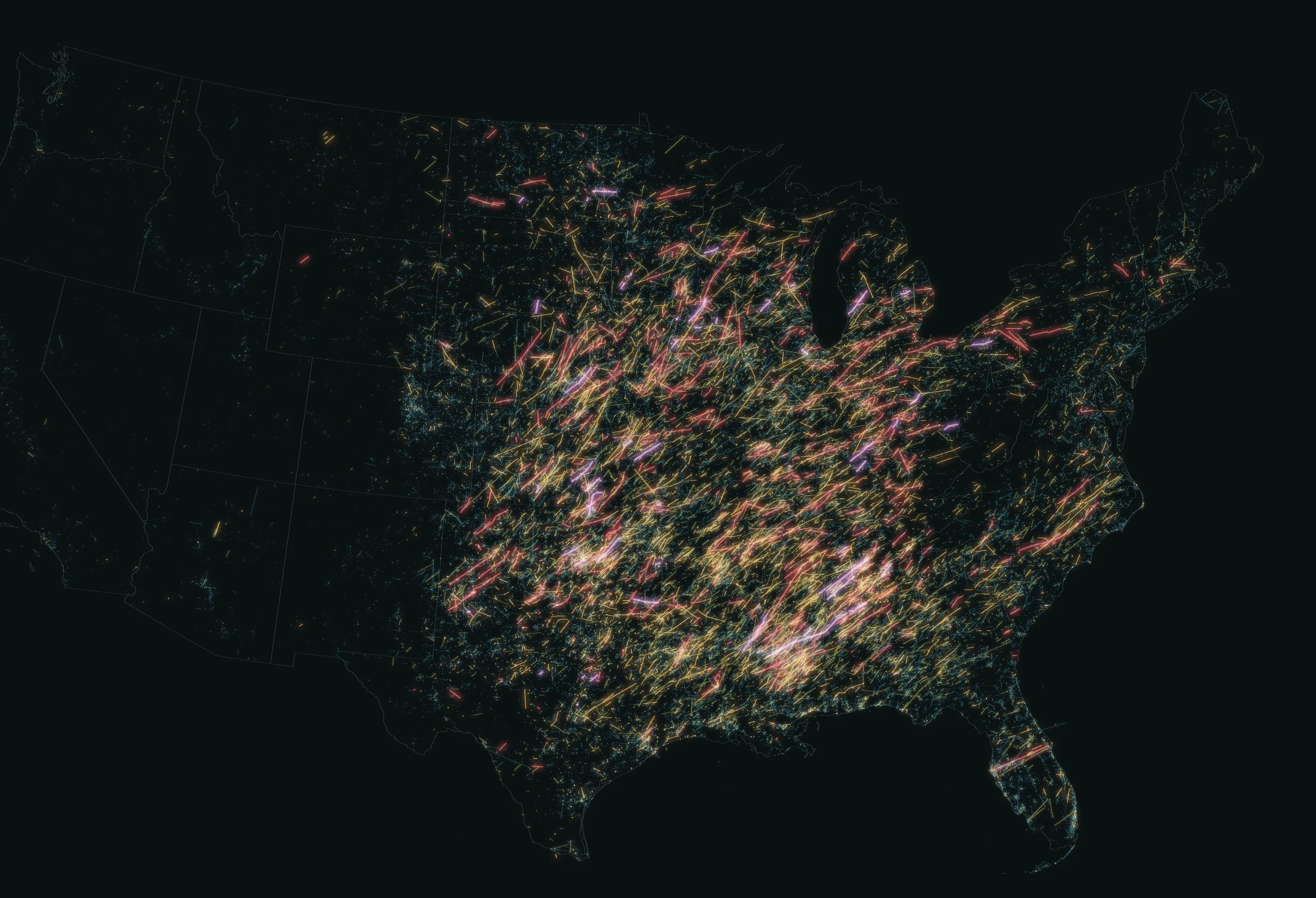
Every tornado since 1950. Find the ones that came near you.
Type an address. We measure to each tornado’s surveyed path, not to where it touched down, and show you the National Weather Service’s own account of the storm.
We couldn’t get your location. Check that location access is allowed for this site, or type an address.
Try Moore, OK · Joplin, MO · Tuscaloosa, AL · Mayfield, KY
Reading a rating
An EF rating is a damage survey, not a wind measurement.
Nobody measures the wind inside a tornado. After the storm, a National Weather Service team walks the path and rates the tornado by the worst damage it can find. A violent tornado that crosses empty fields can only be rated by what it hit: El Reno, 2013, the widest tornado ever recorded at 2.6 miles, is officially an EF3. Before 2007 the scale was Fujita’s original F-scale; the bars combine both.
Shingles peeled, gutters gone, branches down.
Roofs badly stripped, mobile homes overturned, windows broken.
Roofs torn off well-built houses, mobile homes destroyed, big trees snapped.
Whole stories of well-built houses destroyed; big buildings badly damaged.
Well-built houses levelled.
Strong frame houses swept off their foundations; concrete structures badly damaged.
Wind ranges are the Enhanced Fujita scale’s estimated 3-second gusts. Counts are tornadoes by their peak rating, 3,468 more were never rated.
Tornadoes people still search for
The latest strong tornadoes in the record
EF3 and stronger, newest first. NOAA publishes the database a few months behind the weather.
Tornadoes by state
Every tornado since 1950, ranked. A tornado that crossed a state line counts in both.